
Manager Pairings to Counter Periodic Underperformance
June 16, 2026 | Derek Beiter
“In this world, nothing can be said to be certain, except death and taxes”
– Benjamin Franklin
… “and your investment manager hitting a patch of underperformance”
– LPL Research (only partly in jest)
According to our latest study of active management, 96% of active U.S. equity mutual funds with a 10-year record had at least one three-year period of underperformance relative to their assigned benchmark at some point over the last 10 years. This same set of funds outperformed in roughly half (47%) of the periods. So, while active management was not poor overall, and pockets of strong performance occurred, it has been extremely difficult for any given manager to never underperform.
One strategy for dealing with the near-inevitability of manager underperformance is manager pairings. Even within a particular equity asset class, such as large cap growth, it may be prudent to utilize two funds or managers. The basic logic is as follows.
- Identify two investment managers believed to offer outperformance potential over a full market cycle. This may be based upon historical tendencies and a going-forward assessment of whether the historical patterns are expected to persist.
- Identify the points in time when each manager has tended to perform particularly well or poorly. Even if a manager has not underperformed during its existing history, it is still important to anticipate adverse market environments that may cause future underperformance.
- Determine the allocation to each manager in the pairing. This could be a simple 50/50 blend or include a tilt towards a manager in which the investor is more confident or expects to be more consistent.
A Tale of Two Funds or Managers
The chart titled “Rolling Three-year Excess Returns versus Benchmark” shows rolling three-year excess returns for two hypothetical funds or managers. Excess return is simply the return of the investment minus the return of the benchmark index. Plots above zero indicate periods when the investment is outperforming, and plots below zero indicate periods of underperformance.
- Fund or Manager A (shown with a blue line) is a hypothetical active investment portfolio with a solid track record, outperforming its benchmark index in 68% of the rolling three-year periods over the last 10 years. Still, it had periods of underperformance, including the three-year periods ending in 2018–2020 and the most recent three-year periods.
- Fund or Manager B (orange line) is a hypothetical active investment portfolio with a solid track record, outperforming its benchmark index in 58% of the rolling three-year periods over the last 10 years. Its underperformance occurred in the three-year periods ending in 2016 and 2017, as well as in 2022–2024.
- The second chart, titled “Rolling Three-year Excess Returns of a 50/50 Blend,” shows the hypothetical performance of pairing Manager A and Manager B in equal allocations. The hypothetical blend has increased the consistency of relative performance, with the pairing outperforming the benchmark in 95% of time periods.
Rolling Three-Year Excess Returns versus Benchmark
A hypothetical illustration

Source: LPL Research 03/31/26.
Disclosure: This is a hypothetical illustration, not the actual performance of a particular investment.
Rolling Three-Year Excess Returns of a 50/50 Blend
A hypothetical illustration
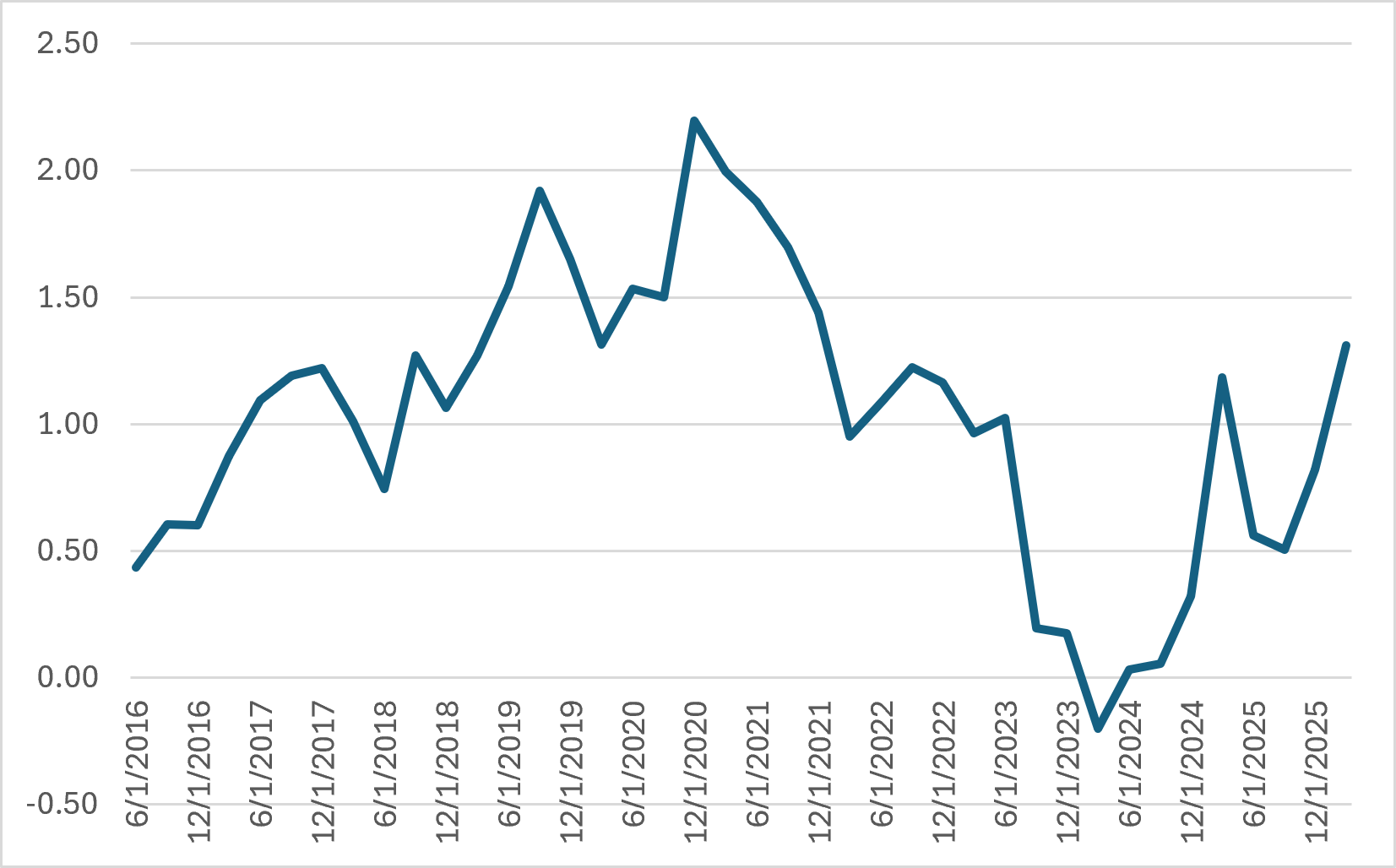
Source: LPL Research 03/31/26.
Disclosures: This is a hypothetical illustration, not the actual performance of a particular investment. The investments were rebalanced back to a 50/50 weighting on a quarterly basis.
Why Good Managers Have Pockets of Bad Performance
- A manager may emphasize securities of a certain type that have gone out of favor with investors, such as high-quality stocks during a low-quality rally or deep value stocks during a growth stock rally.
- They may take less risk than the index, underperforming during sharply advancing market environments.
- Ineffective stock selection. For a period of time, they may simply have chosen stocks that have underperformed those present in the benchmark index.
The Upshot
Some investors may question the merits of having two managers in the same asset class instead of picking one favorite manager. Even a manager with a strong performance record can be expected to have periods of difficulty outperforming the benchmark. Rather than putting all our eggs in that manager’s basket, we can attempt to anticipate times when that manager may struggle and select a complementary manager whose returns may “zig” when the other manager “zags.” If the investor expects both managers to outperform over a full market cycle, adding a second strong-performing manager may not necessarily reduce long-term returns. By pairing two managers together in the same asset class, investors may potentially benefit in these important ways:
- Increase the consistency of relative performance
- Reduce volatility
- Lessen the temptation of selling an underperforming manager that may be poised for a recovery
Important Disclosures
This material is for general information only and is not intended to provide specific advice or recommendations for any individual. There is no assurance that the views or strategies discussed are suitable for all investors. To determine which investment(s) may be appropriate for you, please consult your financial professional prior to investing.
Investing involves risks including possible loss of principal. No investment strategy or risk management technique can guarantee return or eliminate risk.
Indexes are unmanaged and cannot be invested into directly. Index performance is not indicative of the performance of any investment and does not reflect fees, expenses, or sales charges. All performance referenced is historical and is no guarantee of future results.
This material was prepared by LPL Financial, LLC. All information is believed to be from reliable sources; however LPL Financial makes no representation as to its completeness or accuracy.
Unless otherwise stated LPL Financial and the third party persons and firms mentioned are not affiliates of each other and make no representation with respect to each other. Any company names noted herein are for educational purposes only and not an indication of trading intent or a solicitation of their products or services.
Asset Class Disclosures –
International investing involves special risks such as currency fluctuation and political instability and may not be suitable for all investors. These risks are often heightened for investments in emerging markets.
Bonds are subject to market and interest rate risk if sold prior to maturity.
Municipal bonds are subject and market and interest rate risk and potentially capital gains tax if sold prior to maturity. Interest income may be subject to the alternative minimum tax. Municipal bonds are federally tax-free but other state and local taxes may apply.
Preferred stock dividends are paid at the discretion of the issuing company. Preferred stocks are subject to interest rate and credit risk. They may be subject to a call features.
Alternative investments may not be suitable for all investors and involve special risks such as leveraging the investment, potential adverse market forces, regulatory changes and potentially illiquidity. The strategies employed in the management of alternative investments may accelerate the velocity of potential losses.
Mortgage backed securities are subject to credit, default, prepayment, extension, market and interest rate risk.
High yield/junk bonds (grade BB or below) are below investment grade securities, and are subject to higher interest rate, credit, and liquidity risks than those graded BBB and above. They generally should be part of a diversified portfolio for sophisticated investors.
Precious metal investing involves greater fluctuation and potential for losses.
The fast price swings of commodities will result in significant volatility in an investor’s holdings.
This research material has been prepared by LPL Financial LLC.
Not Insured by FDIC/NCUA or Any Other Government Agency | Not Bank/Credit Union Deposits or Obligations | Not Bank/Credit Union Guaranteed | May Lose Value
For Public Use – Tracking: #1124106