
Bond Prices Make Noise, but Income Drives the Returns
October 08, 2026 | Lawrence Gillum
The Price Is Noise. The Income Is the Return.
Every time rates jump, the headlines follow the same script: bonds got hit. On a statement, they did. But that framing confuses two very different activities. Trading bonds is about where prices go next. Investing in bonds is about building a portfolio that pays you income for as long as possible. For investors, the price move is the least important number on the page.
Take a five-year bond yielding 4.5%. Its price sensitivity to rates, also known as duration, is roughly 4.4, so a one percentage point rise in yields knocks about 4.4% off its value. Now compare that to what it pays: 4.5% per year, every year, on average. One year of income covers the damage from a full point rise in rates. Over five years, the bond delivers roughly 22.5% in income, and because a bond held to maturity returns its full face value, the paper loss works its way back anyway.
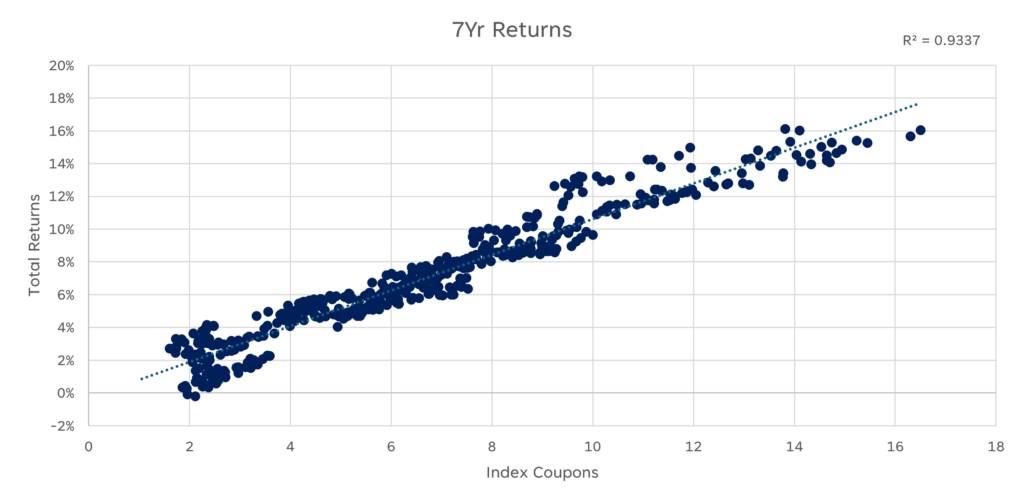
Bond funds and exchange-traded funds (ETFs) don’t mature, which can make investors nervous because there’s no maturity date pulling the NAV back toward par. But the same basic math still applies, just through a different mechanism. As bonds mature, funds reinvest the proceeds at prevailing yields. When rates rise, NAVs fall initially, but the portfolio’s income stream begins to rise as well. Over a holding period roughly equal to the fund’s duration, that higher income can help offset the initial price decline. Consider the Bloomberg Aggregate Bond (Agg) Index, which has generally had a duration of roughly six to seven years over the past decade. During that period, starting yields and subsequent seven-year returns have had a correlation of around 94%. The relationship isn’t perfect, in part because index rules require bonds with less than one year to maturity to roll out of the index, but the message is clear: starting yields have historically been a powerful indicator of longer-term bond returns. And there’s a simple reason why. Over time, income, not price movement, has been the predominant driver of fixed income returns.
Agg Yield is Destiny: Future Returns are Highly Correlated to Starting Yields
Source: LPL Research, Bloomberg 10/07/26. Past performance is no guarantee of future results. Indexes are unmanaged and cannot be invested in directly.
This is why rising rates are not the enemy of an income investor. They are a raise. Every interest payment and every maturing bond gets reinvested at higher yields, lifting the income stream you’ll collect for years to come. The goal isn’t to avoid ever seeing a red number. It’s to keep the income coming, and keep it growing, for as long as you can.
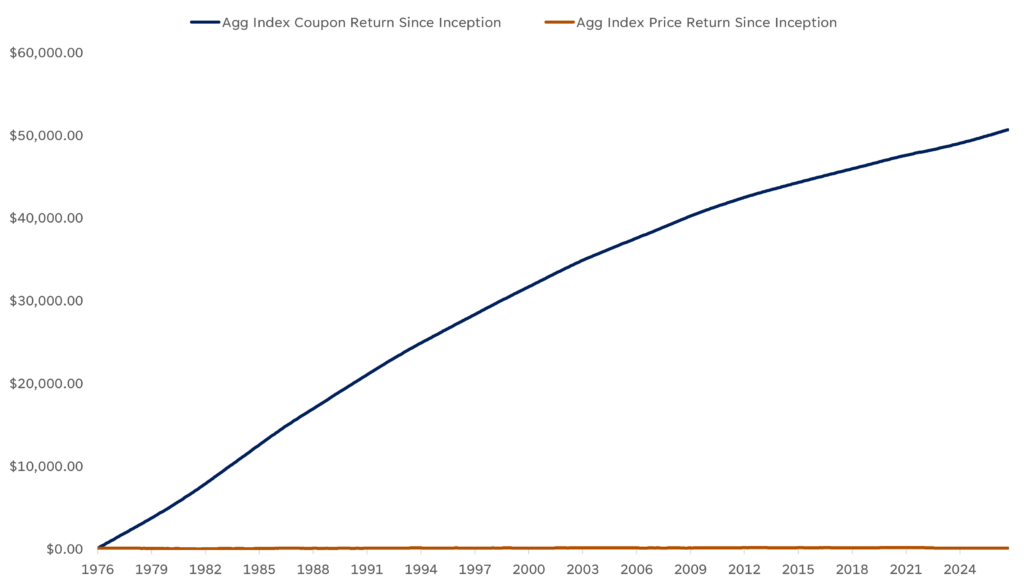
History backs this up, though past performance does not guarantee future results. Over the past several decades, income has accounted for the vast majority of the Agg’s total return. Prices swung year to year but largely netted out. The income compounded.
Fixed Income’s Return Engine: Income
Source: LPL Research, Bloomberg 10/07/26. Past performance is no guarantee of future results. Indexes are unmanaged and cannot be invested in directly.
2022 is the exception that proves the rule. The bond market lost about 13%, its worst year on record, and many fund investors watched NAVs fall by double digits. But the market started that year yielding under 2%, with no income cushion to absorb the shock. Today, with yields in the 5% to 6% range, that cushion is two to three times larger.
Price moves matter if you need to sell next month. But investors typically don’t own bonds to sell them next month. They own them to fund future spending, steady a stock-heavy portfolio, and generate potential cash flow. So when the next rate scare hits, look past the price and the NAV and ask what you’re getting paid, and for how long. At current levels, the answer is a lot. That’s the number that compounds.
Important Disclosures
This material is for general information only and is not intended to provide specific advice or recommendations for any individual. There is no assurance that the views or strategies discussed are suitable for all investors. To determine which investment(s) may be appropriate for you, please consult your financial professional prior to investing.
Investing involves risks including possible loss of principal. No investment strategy or risk management technique can guarantee return or eliminate risk.
Indexes are unmanaged and cannot be invested into directly. Index performance is not indicative of the performance of any investment and does not reflect fees, expenses, or sales charges. All performance referenced is historical and is no guarantee of future results.
This material was prepared by LPL Financial, LLC. All information is believed to be from reliable sources; however LPL Financial makes no representation as to its completeness or accuracy.
Unless otherwise stated LPL Financial and the third party persons and firms mentioned are not affiliates of each other and make no representation with respect to each other. Any company names noted herein are for educational purposes only and not an indication of trading intent or a solicitation of their products or services.
Asset Class Disclosures –
International investing involves special risks such as currency fluctuation and political instability and may not be suitable for all investors. These risks are often heightened for investments in emerging markets.
Bonds are subject to market and interest rate risk if sold prior to maturity.
Municipal bonds are subject and market and interest rate risk and potentially capital gains tax if sold prior to maturity. Interest income may be subject to the alternative minimum tax. Municipal bonds are federally tax-free but other state and local taxes may apply.
Preferred stock dividends are paid at the discretion of the issuing company. Preferred stocks are subject to interest rate and credit risk. They may be subject to a call features.
Alternative investments may not be suitable for all investors and involve special risks such as leveraging the investment, potential adverse market forces, regulatory changes and potentially illiquidity. The strategies employed in the management of alternative investments may accelerate the velocity of potential losses.
Mortgage backed securities are subject to credit, default, prepayment, extension, market and interest rate risk.
High yield/junk bonds (grade BB or below) are below investment grade securities, and are subject to higher interest rate, credit, and liquidity risks than those graded BBB and above. They generally should be part of a diversified portfolio for sophisticated investors.
Precious metal investing involves greater fluctuation and potential for losses.
The fast price swings of commodities will result in significant volatility in an investor’s holdings.
This research material has been prepared by LPL Financial LLC.
Not Insured by FDIC/NCUA or Any Other Government Agency | Not Bank/Credit Union Deposits or Obligations | Not Bank/Credit Union Guaranteed | May Lose Value
For Public Use – Tracking: #1188453